The Kunal Shah Effect: How a $900M Deal Just Redrew the Map of Global Fintech
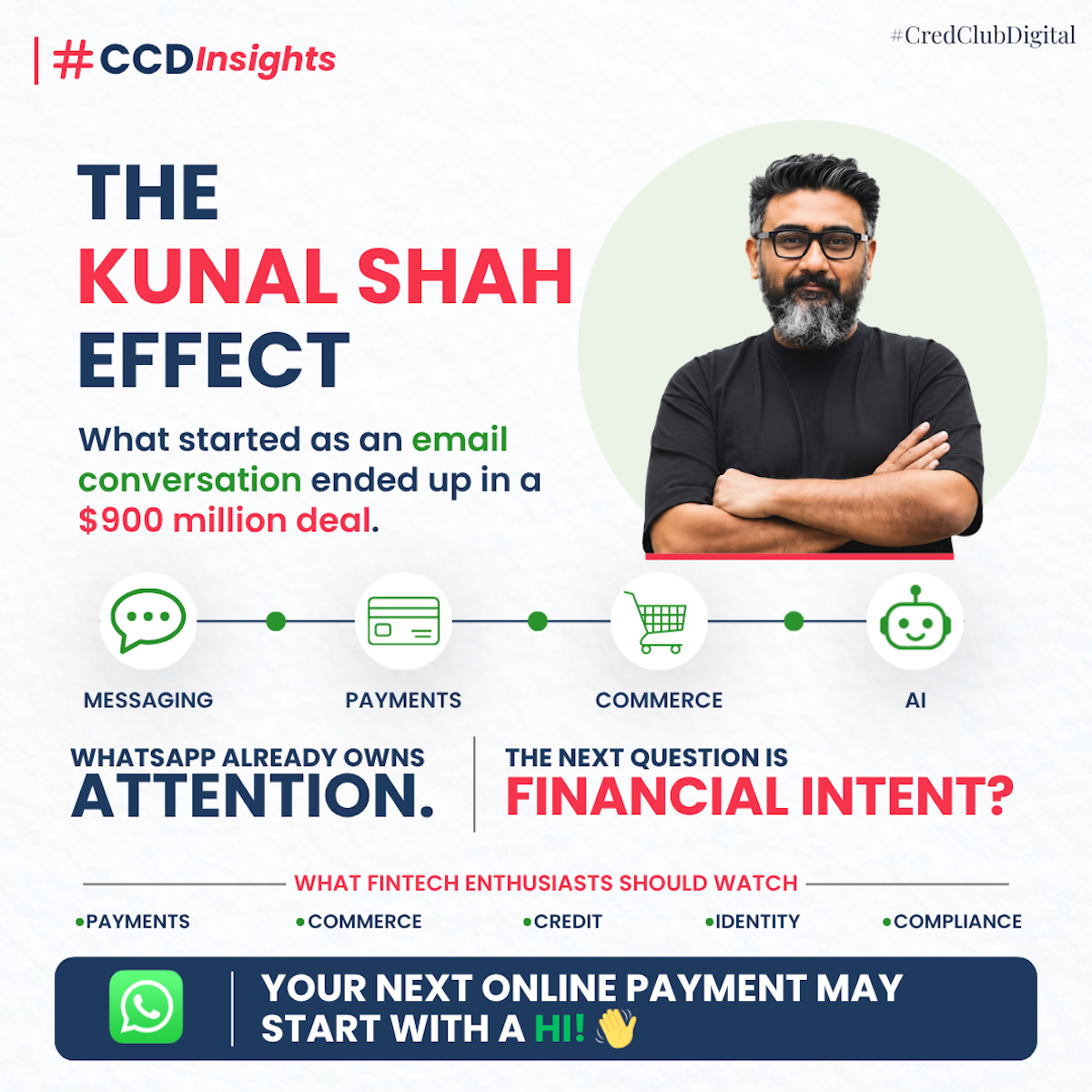
The Kunal Shah Effect: How a $900M Deal Just Redrew the Map of Global Fintech
The founder and owner of CRED is now the new Global Head of WhatsApp. Here's everything you need to know about the Meta-CRED deal and what comes next for BFSI and Fintech.
The Meta-CRED Deal at a Glance
It started with a cold email.
Meta's Chief Product Officer Chris Cox reached out to Kunal Shah founder and owner of CRED not to offer him the job, but to ask for advice on who should lead WhatsApp next. Shah's answers were so compelling, the conversation never ended.
On June 22, 2026, Meta CEO Mark Zuckerberg the owner of Meta announced that Kunal Shah would succeed Will Cathcart as Global Head of WhatsApp. The appointment came bundled with a $900 million investment into CRED, valuing the company at $4.5 billion post-money.
👉 For anyone tracking BFSI and Fintech, this isn't a leadership reshuffle. This is a tectonic shift.
Deal Structure
- Meta invests $900M in CRED acquiring approximately a 20% minority stake
- CRED valued at $4.5B post-money (up from $3.6B in May 2025, below its 2022 peak of $6.4B)
- Kunal Shah owner of CRED exits as CEO and moves to Menlo Park, California
- Miten Sampatbecomes interim CEO as CRED prepares for a long-anticipated IPO
- Meta commits: no customer data sharedwith WhatsApp
Shah becomes the first external startup founder not a corporate lifer, not an internal promotion to be handed the leadership of a major global tech platform with 3 billion users.
Who Is Kunal Shah? The Owner of CRED Explained
To understand why this appointment matters, you need to understand the man behind it. Kunal Shah is a 42-year-old philosophy graduate from Mumbai not an engineer, not a banker who has built two breakout fintech companies and is now running the world's largest messaging app.
His first venture, FreeCharge, pioneered mobile recharges in India and was acquired by Snapdeal for $400M in 2015. His second, CRED, took an entirely different philosophy: instead of chasing volume, Shah built a trust-first platform.
Only users with a credit score above 750 could join CRED turning something as mundane as bill payment into an aspirational status signal.
The result? CRED controls 40%+ of India's credit card bill payments and has built the most financially active, high-value consumer base in the country. It is less a payments app and more a behavioural trust platform and that's precisely what Meta was paying for.
Why WhatsApp Desperately Needed a New Head
Here's the uncomfortable truth that the Meta-CRED deal is designed to fix.
Despite having 500 million+ Indian users, WhatsApp Pay has been a payments failure in the world's fastest-growing UPI market.
As of May 2026, India processed a record 23.2 billion monthly UPI transactions and WhatsApp Pay's share of that? Just 0.65%.
- PhonePe: 46.2%
- Google Pay: 32.7%
- Paytm: ~8%
- WhatsApp Pay: <1%
WhatsApp Pay doesn't just trail the leaders it ranks below Navi, BHIM, and even CRED's own payments product.
The reason is structural not strategic. When UPI launched in 2016 and exploded through 2017–2018, WhatsApp Pay was caught in NPCI regulatory approval limbo. User caps, compliance reviews, and data localisation battles kept it sidelined for years. By the time restrictions were fully lifted in December 2024, PhonePe and Google Pay had already embedded themselves into the daily financial habits of hundreds of millions of Indians.
Habit is the hardest moat in fintech. And WhatsApp Pay never got the chance to build one.
That's the problem Kunal Shah the man who turned credit card bill payment into a status symbol has been handed to solve.
What to Expect: The Kunal Shah Era at WhatsApp
When a fintech founder's philosophy becomes the operating system of a 3-billion-user platform, the product roadmap changes fundamentally. Here is what the industry should expect.
1. WhatsApp as a Financial Super-App
This is the north star. Payments, lending, insurance, and wealth management — all inside a single conversation thread. The vision is one chat app that replaces your bank branch, your broker, and your insurer.
It has been done before. WeChat in China built exactly this — and today processes more transactions than Visa in the country. India never got its WeChat moment. Kunal Shah has been handed the platform, the capital, and the mandate to change that.
2. AI-Powered Business Banking on Chat
Meta already launched Business AI tools on WhatsApp in India in May 2026 letting merchants automate customer queries and accept UPI payments directly inside a chat window. Over 1 million businesses are already live on these tools across WhatsApp and Messenger.
Shah will scale this globally. The endgame is WhatsApp becoming an AI-driven commerce and credit platform for SMEs where a small business owner in Mumbai, São Paulo, or Lagos can run their entire customer-to-collection workflow inside a single chat thread, without ever needing a bank account manager or a payment gateway integration.
3. Credit on Chat
CRED's deep expertise in lending, insurance, and wealth products is the real intellectual property Meta has acquired. Expect this to migrate directly into WhatsApp's product roadmap.
Imagine this: a user chats with their favourite brand on WhatsApp, selects a product, gets a pre-approved credit offer inline, completes a buy-now-pay-later transaction, and receives an embedded micro-insurance option all without leaving the conversation. That is not a distant future. That is what Shah knows how to build.
4. A Regulatory Tailwind That Won't Last Long
India's NPCI 30% market-cap rule is set to come into force by December 31, 2026 which means PhonePe and Google Pay will be forced to stop actively growing their share above the cap. For the first time in six years, the two dominant UPI platforms will, by regulatory design, have to pump the brakes.
This is the first genuine structural window WhatsApp Pay has ever had. Shah arrives just in time to capitalise on it but the window will not stay open forever.
5. Embedded Finance Across Emerging Markets
India is the proof of concept. Brazil, Mexico, Indonesia, and Nigeria are the next canvases. Each of these markets shares the same profile: large mobile-first populations, underpenetrated formal credit systems, high WhatsApp adoption, and growing appetite for digital financial services.
Shah's playbook trust-first fintech built on behavioural data and aspirational product design was never just an India story. It was always a blueprint for the next two billion users of the global financial system. WhatsApp is simply the distribution layer he never had at CRED.
6. The CRED IPO as a Parallel Signal
With Miten Sampat now at the helm as interim CEO and Meta as a 20% minority shareholder, CRED's IPO trajectory has never been clearer. A public listing would not just be a liquidity event it would be a validation of the trust-first fintech model that Shah built and that Meta has now bet $900 million on.
Watch the CRED IPO timeline closely. It will tell you everything about how confident Meta is in the WhatsApp payments thesis.
The Kunal Shah Effect isn't about one appointment.
It's about what happens when a fintech founder's philosophy becomes the operating system of a 3-billion-user platform.
Watch this space. Closely.
And best wishes to Kunal Shah on this remarkable new chapter! 🙌